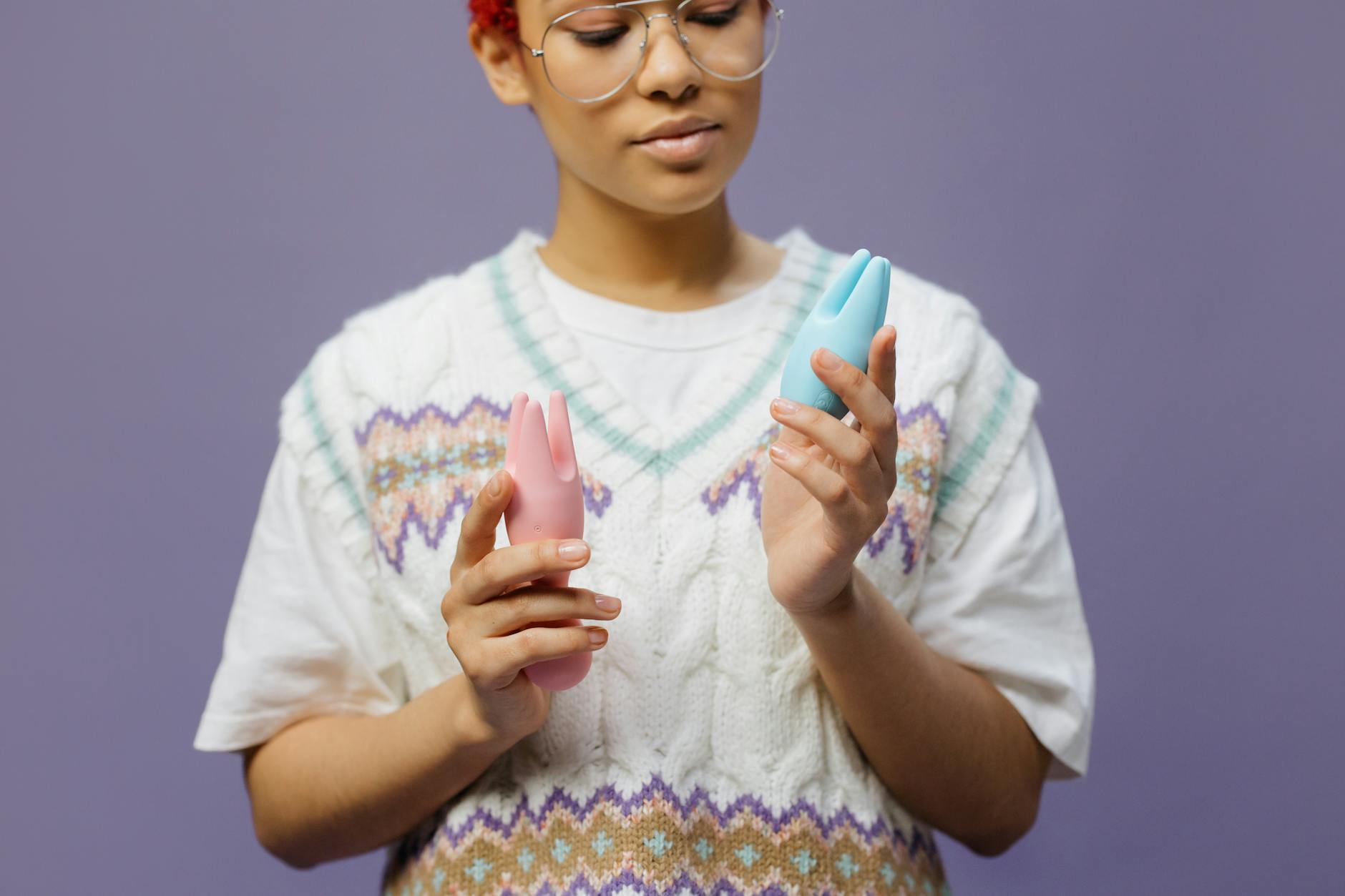
Your clitoris is not a fixed target
Here's the thing nobody tells you: your clitoris does not feel the same way twice a month. It swells and softens. It becomes more or less responsive. The vibration intensity that made you shout during week two might feel abrasive by week four. And that's not a malfunction. It's your body doing exactly what it's supposed to do.
Most people with vulvas cycle through four distinct phases of clitoral sensitivity. Each one has its own rhythm, its own preferences, its own version of what feels good. Learning to recognize these shifts, and adjusting your lemon clitoral vibrator accordingly, transforms pleasure from something that feels unreliable into something you can actually count on.
What happens to clitoral sensitivity across your cycle
Your menstrual cycle is ruled by four hormones that rise and fall in a predictable pattern. Estrogen and testosterone both climb during the follicular phase. They peak right before ovulation. Then they drop sharply. Progesterone rises in the luteal phase and stays elevated until menstruation arrives. These hormonal fluctuations change the thickness of clitoral tissue, blood flow to the vulva, and how quickly nerve endings fire.
The practical result: your clitoris is most engorged and responsive around ovulation (days 12-16 of a 28-day cycle). It's least responsive during the late luteal phase, right before your period. But it's not a straight line. Week one (menstruation) feels different from week two (follicular peak). Week three (post-ovulation) feels different from week four (pre-menstrual).
This is not something you can fight. You can only work with it.
Week one: Lower sensitivity, higher comfort threshold
During your period, blood flow is highest. Clitoral tissue is less engorged than it will be later. Your sensitivity is lower overall, which means you can often tolerate higher intensity without discomfort.
This is when many people reach for patterns 5-7 on their lemon vibrator and feel satisfied, whereas mid-cycle they'd find the same intensity overwhelming.
The play here: if you love intense, prolonged stimulation, your period week is your sandbox. Use it to explore higher settings. Use suction intensity you might avoid other weeks. Your clitoris is less vulnerable to overstimulation right now, so you can be bolder.
That said, menstrual cramping sometimes competes with pleasure. If your pelvic floor is tight from cramping, a lemon vibrator's suction can feel less pleasurable than it does when your baseline muscle tension is lower. In that case, a warm bath, a heating pad, or 10 minutes of pelvic floor relaxation (the opposite of Kegels) beforehand helps. You're not broken. You're just working with an additional variable.
Week two: Peak sensitivity, pattern exploration
The follicular phase after your period ends is when estrogen and testosterone rise steadily. By week two, your clitoris is noticeably more engorged. Texture feels richer. Light touch becomes more pleasurable. You notice details you didn't feel a week ago.
This is when people often say "my lemon vibrator feels totally different today," and they're right. It actually is, because your tissue has changed.
The window: you can start with lower patterns (1-3 on most lemon sucker devices) and feel profound sensation. You might find that patterns you skipped last week are now your favorites. Many people orgasm faster and more easily this week, which is worth knowing if you have a partner and are coordinating timing.
The tactical move: if you want to map what different patterns of your lemon clitoral vibrator feel like, do it now. Your clitoris is the most communicative this week. You'll learn what you actually prefer instead of what you thought you should prefer.
Week three: Ovulation peak, then descent
Ovulation happens around day 14. Right before it, sensitivity is at its absolute highest. Days 12-16 are often the most responsive window of your cycle. This is when lightest touch from a lemon vibrator feels incredible. This is when orgasms can come quickly and intensely.
Then ovulation happens, and progesterone begins to rise. By day 17 or 18, you'll notice the shift. Not dramatically, but noticeably. Your clitoris is still responsive, but it's starting to calm down.
Plan accordingly: if you're using a lemon vibrator solo during your ovulation window, you might finish in five minutes. If your partner is involved and you're coordinating, that's useful information. And if you're someone who prefers longer, more meditative sessions, ovulation week might not be your favorite. That's information too.
After ovulation, you're not losing pleasure. You're just moving into a different kind of pleasure. The frenetic energy of the ovulatory phase mellows into something steadier.
Week four: Progesterone dominance, patience required
The luteal phase, especially days 21-28, is when progesterone is highest and estrogen has dropped again. Your clitoris is less engorged. The tissue is drier. Sensitivity is lower. This is when people often say "my lemon vibrator isn't working the way it was last week," and yes, that's because your body has changed.
This is not the week to expect the same five-minute intensity you had at ovulation. This is the week that rewards patience and different stimulation patterns.
What works here: longer warm-up time (15-25 minutes instead of 5-10). Lubrication becomes more important even if you didn't need it other weeks. Lower initial intensity that you build from. Combining clitoral stimulation with other touch, instead of relying solely on your lemon vibrator.
Some people find their best orgasms happen this week, not because of peak sensitivity, but because they've finally stopped rushing. They've made space. They've brought lube. They've invested the time. The reward is different, but it's real.
Tracking your own pattern
Here's the move: for one full cycle, note the day of your period and how your lemon vibrator feels. Not "good" or "bad," but specifically: how long does it take to feel aroused? Which patterns feel best? Do you need lube? How quickly do you orgasm? What intensity do you prefer?
After one cycle, you'll see your own personal pattern emerge. Most people find they have two or three "peak" days where pleasure is effortless, one or two "rebuilding" days where pleasure requires more intention, and a handful of "exploring" days where they discover new preferences.
That's not a deficiency. That's you learning how your body actually works instead of how you thought it was supposed to work.
Practical adjustments for your lemon vibrator setup
Three things to keep accessible:
Water-based lubricant. Your body's natural lubrication varies across your cycle. Weeks one and four need it more than weeks two and three. Keeping it nearby means you're never caught off-guard by the feeling of reduced wetness.
A timer or phone note. Not because you're tracking for a partner or therapist, but because you might forget. "Today is day 14" doesn't stick in memory unless you write it down.
Different intensity expectations. Not a different lemon clitoral vibrator, necessarily, just a different baseline. When you move from week two to week three, you're not failing at pleasure if patterns that worked last week feel intense now. You're succeeding at adaptation.
When to talk to someone
If your sensitivity doesn't vary across your cycle at all, that's also totally normal. Not everyone experiences pronounced changes. If you do experience changes but they're erratic, unpredictable, or accompanied by pain, hormonal imbalances are worth discussing with a healthcare provider. Polycystic ovary syndrome, thyroid issues, and other conditions can flatten or scramble your cycle's usual rhythm.
Similarly, if you've been taking hormonal birth control and you've recently stopped, expect a few months of adjustment while your body relearns its own pattern. Your lemon vibrator will feel different than it did on the pill because your hormones have changed. That's not permanent. That's your baseline resetting.
The permission you actually need
Your pleasure is not supposed to be the same every single day. Your body was never designed to perform identically across 28 days. Expecting yourself to have the same response to lemon vibrators, or any touch, every week is like expecting to want the same food every single day regardless of season. You don't. Your body doesn't. Your clitoris definitely doesn't.
The deeper shift happens when you stop seeing this variation as a problem and start treating it as information. Information about your cycle. Information about what your body needs. Information that helps you choose the right lemon sucker pattern, the right intensity, the right timing.
Your pleasure deserves that level of attention. Not because you need to optimize it into perfection, but because you deserve to understand it. And understanding it means everything gets better, consistently, across all four weeks.
FAQ: Clitoral sensitivity and your cycle
Why does my lemon vibrator feel different depending on the week?
Your clitoris physically changes across your cycle. It swells during the follicular phase and ovulation, then gradually softens in the luteal phase. This affects tissue thickness, blood flow, and how responsive nerve endings are. Your lemon clitoral vibrator isn't different. Your clitoris is. That's not a problem. It's your body working as designed.
Can I use my lemon sucker the same way every day?
You can, but you might not want to. Many people find that matching their intensity and pattern choices to their cycle phase results in more consistent pleasure and fewer sessions that feel "off." That said, some people experience minimal variation and prefer consistency. Tracking one cycle will show you your own pattern.
Does birth control stop my clitoral sensitivity from changing?
Hormonal birth control flattens hormonal fluctuations, which means many people report more consistent sensitivity across the month on the pill, ring, or patch. The trade-off is that peak sensitivity might be lower overall. It's individual. If you've recently started or stopped hormonal contraception, expect a few months for your body to adjust and for your lemon vibrator to feel like "itself" again.
What if my sensitivity doesn't follow this four-week pattern?
Every cycle is individual. Some people have a 25-day cycle instead of 28, which compresses these phases. Others have irregular cycles where sensitivity doesn't follow a predictable pattern. Some people, regardless of cycle, simply don't experience pronounced sensitivity shifts. None of these are problems. They're just your baseline. Track what you actually experience rather than what you think you should experience.
Should I avoid my lemon vibrator during certain weeks?
No. Your lemon clitoral vibrator is safe to use any day of your cycle. What changes is not safety, but preference. You might prefer different patterns, different timing, or different intensities. Some people find their most satisfying orgasms happen during their luteal phase (weeks three and four) when they've finally slowed down enough to be present. Others prefer their ovulation window. Both are valid.
How do I know if my sensitivity changes are abnormal?
Significant pain, total loss of sensation, or wildly unpredictable swings (where you can't sense any pattern across three months) are worth checking in about with a healthcare provider. But mild variation in arousal time, orgasm intensity, or pattern preference is normal. If you're unsure whether what you're experiencing is typical, there's no harm in asking a gynecologist or reproductive endocrinologist.
Can I use a lemon vibrator to regulate my cycle?
Orgasms increase blood flow and can sometimes help move stagnant fluid during menstruation, which some people find reduces cramping. But no, you can't use pleasure to regulate an irregular or problematic cycle. Cycle regulation requires hormonal or physiological intervention. What you can do is use your lemon sucker to feel better during menstruation, which is valuable on its own.
What's the best pattern for each week?
There is no universal best. What feels best depends on your individual sensitivity, your partner (if applicable), and what you're trying to achieve. During peak sensitivity (weeks two and three), most people prefer lower intensities. During lower-sensitivity weeks, many prefer higher patterns. But the only way to know is to track your own experience with your lemon clitoral vibrator across a full cycle.
The rhythm continues
Your cycle is not a limitation on your pleasure. It's the foundation of it. Once you understand how your clitoris actually behaves across four weeks, you stop fighting your body and start working with it. Your lemon vibrator stops feeling unpredictable and starts feeling like a tool you know how to use, adjusted for the week you're in.
That's not fine-tuning. That's expertise. And you deserve it.
Ready to explore more about working with your body's natural rhythms? We cover how to use lemon vibrators when arousal takes longer to build and strategies for matching your pleasure practices to your hormonal shifts. Both dig into real-world timing and adjustment strategies.
Questions about your own cycle or sensitivity patterns? Get in touch. That's what we're here for.